
 VISIT OUR BLOG
 CONTACT US


How YOU could be Benefiting from Glass Reinforced Plastics Design innovation is everywhere right...
How YOU could be Benefiting from Glass Reinforced Plastics
Design innovation is everywhere right now. Just drive through any town or city, and you'll spot buildings that catch your eye, brand new ones or old ones that have been totally transformed. Creativity has made a real comeback in architecture, and it goes well beyond appearances. There is quite a lot more happening beneath the surface. Architects and engineers are even finding ways to innovate through the materials used in the design.
Today’s buildings are becoming increasingly more efficient. Materials are chosen for both visual appeal and functionality. Traditional materials such as wood and metal are becoming less significant compared to newer materials. 
Glass Reinforced Plastic (GRP)
One material that has grown considerably in popularity is GRP — a composite made from thermoset resin reinforced with fine glass strands. Once cured, it offers superior performance characteristics compared to traditional building materials such as wood and metal, which is why architects and engineers are increasingly moving away from them. The key benefits that set GRP products apart are outlined below.
 |
Corrosion Resistance |
||
|
GRP is highly resistant to both corrosive chemicals and environmental exposure.
|
|||
 |
High Strength to Weight Ratio |
||
|
GRP delivers outstanding physical properties at a fraction of the weight of metal.
|
|||
 |
Low Maintenance |
||
|
Unlike metal or wood, GRP does not rust or decompose over time, meaning it requires no scraping, sandblasting, or painting. This makes it low maintenance and significantly extends its working life.
|
|||
 |
Low Installation Cost |
||
|
The ease of fabrication and the light weight of GRP help reduce installation costs.
|
|||
 |
Slip Resistance |
||
|
Fibreglass grating from Fibergrate Composite Structures Inc. is slip-resistant, thus dramatically improving worker safety.
|
|||
 |
Fire Retardance |
||
|
GRP is highly fire-retardant. Most Fibergrate GRP products achieve a flame spread rating of 25 or less when tested in accordance with ASTM E-84, and also meet the self-extinguishing requirements of ASTM-635.
|
|||
 |
Long Service Life |
||
|
Its outstanding durability and corrosion resistance give GRP a significantly longer service life than traditional materials.
|
|||
 |
Lightweight |
||
|
GRP is remarkably lightweight, making transportation and installation significantly more cost-effective and eliminating the need for heavy lifting equipment.
|
|||
 |
Electrically and Thermally Non- Conductive |
||
|
GRP is electrically non-conductive, making it considerably safer than metal and similar traditional materials. Its low thermal conductivity also contributes to superior energy efficiency and greater comfort in contact applications.
|
|||
 |
Impact Resistance |
||
|
Properly designed GRP products can be extremely durable, as demonstrated by the drop test conducted on the moulded grating provided by Fibergrate Composite Structures (see the video at the end of this blog). |
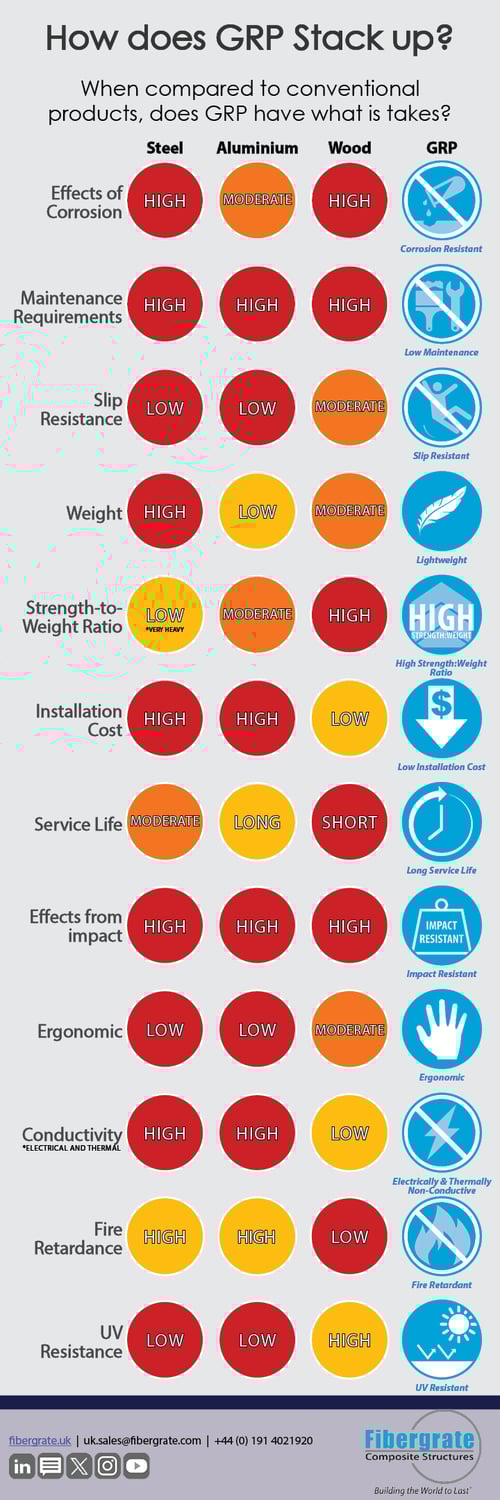
Across every key performance metric, from corrosion resistance and maintenance requirements to strength-to-weight ratio and service life, GRP consistently outperforms steel, aluminium, and wood. For UK contractors looking for a material that delivers long-term value, reduced downtime, and superior durability in demanding environments, the case for GRP is clear. It's not just a material choice; it's a smarter investment.
Still considering steel? Watch the Fibergrate drop test and see why UK contractors are making the switch to GRP moulded grating.
